Let’s be honest: life involves a lot of heavy lifting. Whether you are hauling a week’s worth of groceries in one ambitious trip, scooping up a sleeping toddler, or wrestling with a heavy delivery box, your spine is constantly working to support you.
If you’ve ever reached for something simple—like a dropped pen or a laundry basket—and felt that sudden, terrifying "twinge" in your lower back, please know that you are not alone, and you are not broken. As a chiropractor, I hear this story every day. We often blame these moments on being "out of shape" or "getting older," but the truth is usually much more empowering.
Your spine is an incredibly resilient, beautifully designed structure. Most lifting injuries don't happen because you lack strength; they happen because of a simple misunderstanding of your body's geometry. Lifting isn't just about muscle; it’s an act of physical mindfulness. When we learn to move the way our bodies were designed to move, the heavy burdens of daily life become so much easier to bear.
Here is your practical, supportive guide to lifting safely, keeping your joints happy, and protecting your back for the long haul.
I. The Power of the Hinge: Let Your Hips Do the Work
When we think about lifting, we often hear the advice, "lift with your legs, not your back." But what does that actually mean? Think of your body as a team. Your hips are the heavy-duty powerhouses of that team, built for massive mobility and strength. Your lower back, on the other hand, is designed to be the stable, supportive anchor. When we simply "bend over" at the waist to pick something up, we force our lower back to do a job it wasn't built for, putting unnecessary pressure on our spinal discs.
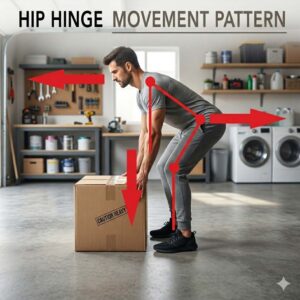
The Pro Example: The Olympic Lifter If you watch a champion weightlifter pull an intimidating amount of weight from the floor, you'll notice their back never rounds. They use a movement called a Hip Hinge. They push their hips back (imagine trying to close a car door with your glutes) while keeping their spine in its natural, comfortable alignment.
How to Use It: Next time you reach down for a heavy box, take a mindful breath. Engage your core gently—imagine you are bracing for a hearty laugh—and push your hips backward. By hinging at the hips instead of rounding your spine, you transfer the workload from the delicate ligaments of your back to the strongest muscles in your body. It is a simple shift, but it is profoundly protective.
II. The "Hug" Rule: Keep the Load Close
Have you ever noticed how a 10-pound bag of rice feels relatively light when you hold it against your chest, but incredibly heavy if you try to hold it straight out in front of you with locked arms? This is the law of leverage at play. The further a heavy object is away from your body's center, the more strain it places on your lower back. Reaching out to lift a heavy object multiplies the force on your spine exponentially.
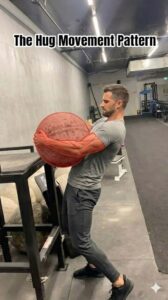
The Pro Example: The Strongman Competitor Consider the athletes who compete in "Strongman" competitions, carrying massive, 300-pound stones across a field. They don't carry the stone out in front of them; they practically wear it. They pull the object tight against their chest and stomach. By doing this, they recruit a thick web of connective tissue in their back (the fascia) to distribute the weight evenly, rather than forcing their small spinal muscles to struggle alone.
How to Use It: I like to call this the "Hug Rule." Whether it’s a bag of potting soil, a heavy suitcase, or your child, step as close to the object as possible before you lift. Once it's in your arms, pull it snug against your body. Make the object part of your own center of gravity. If something is too awkward to hold close to your body, it's a sign that you shouldn't be lifting it alone.
III. The Nose-to-Toes Pivot: Avoid the Twist
If there is one movement that our spinal discs truly dislike, it is twisting while carrying a heavy load. Your spine is brilliant at handling downward compression, but when you combine heavy weight with a twisting motion, it creates a "shearing" force that can easily lead to acute pain or herniation.
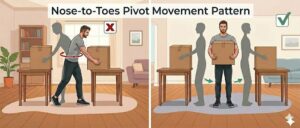
The Pro Example: The Himalayan Sherpa Sherpas are renowned for carrying astonishingly heavy loads up steep, rocky mountainsides. If you watch them walk, you will see a masterclass in spinal safety. They move smoothly and rhythmically, and they never twist at the waist to look behind them or navigate a sharp turn. Instead, they pivot with their feet. Their entire body moves as one solid, cohesive unit.
How to Use It: Imagine there is an invisible string connecting your nose to your toes. Wherever your toes point, your nose should follow. If you pick up a heavy box and need to place it on a table behind you, do not plant your feet and twist your upper body. Instead, take small steps and turn your whole body around. It might take half a second longer, but your spinal discs will deeply appreciate the care.
Additionally, try to balance your load whenever you can. Carrying groceries? Use two bags instead of overloading one side. Carrying a backpack? Use both straps. Keeping your body symmetrical prevents your muscles from constantly fighting to keep you upright.
[Dr. David’s Reflection]
We are all constantly rushing, often treating our bodies simply as vehicles to get us through our massive to-do lists. But taking a moment to focus on how we move is one of the highest forms of self-care. It’s a preventative step that pays dividends every single day.
When you practice the hip hinge, keep your loads close, and remember to pivot instead of twist, you aren't just avoiding injury—you are building a foundation of physical resilience. You are teaching your nervous system that it is safe, strong, and capable. Remember, you don't have to be perfect; you just have to be mindful. Be kind to your spine, listen to your body's signals, and don't hesitate to reach out for an adjustment or guidance when you feel off-balance. We are in this together, and your body is more capable than you know.
References