A patient walks in with long-term knee pain that “just doesn’t get better.”
They’ve often been told:
Understandably, they feel worried. Many think:
“If I have arthritis, I won’t be able to walk properly in the future.”
At the same time, they’re unsure what to do. Some rest too much, while others continue stressing the joint without understanding why it hurts.
Does it sound familiar?
Arthritis is not just one condition
The first step is simple—but often overlooked:
What type of arthritis are we dealing with?
Here’s how I explain it to patients:
1. Osteoarthritis (most common)
This is when the joint is unable to handle the load placed on it over time.
It’s often described as “wear and tear,” but more accurately:
The joint is breaking down faster than the body can adapt and repair.
This is usually influenced by:
2. Rheumatoid Arthritis
This is not a wear-and-tear problem.
It is a condition where:
The body’s immune system mistakenly attacks the joints.
These patients benefit from co-managed care, including medical treatment and, in some cases, complementary approaches such as TCM alongside appropriate medical guidance.
3. Gout
This is a metabolic condition.
Management often includes:
The biggest misconception: “Arthritis is inevitable with age”
One of the most common things I hear is:
“It’s normal—it’s just aging.”
But here’s the problem with that thinking:
If it’s purely age-related, why does one knee degenerate while the other doesn’t?
Both knees are the same age.
This tells us something important: Arthritis is not just about time it’s about how the body is functioning.
Arthritis is often a load and balance problem
Joints don’t simply “wear out for no reason.”
In many cases, there is an underlying issue:
When one part of the body is not functioning well, another part compensates.
Over time:
It’s not just the joint—it’s the system
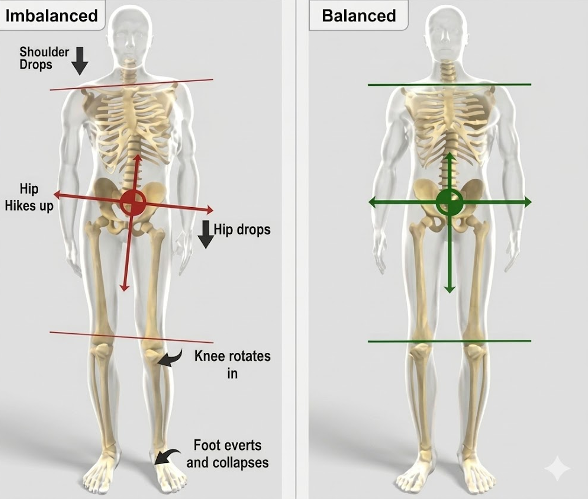
When I assess patients with knee arthritis, I often find:
This is why treating the knee alone is often not enough.
We need to understand how the entire body is contributing to that joint.
Should you rest the joint?
Many patients think:
“If it’s worn out, I should use it less.”
Rest is important—but only at the right time.
If a joint is not used:
This actually will increase wear and tear to the cartilage in the knee over time.
The goal is:
A shift in mindset
Arthritis is common—but it does not mean your life has to slow down.
Many patients improve, move better, and continue living active lives.
But recovery is not passive.
The chiropractor and doctor’s role are to help your body recover faster. Your role is to keep it strong for the long term.
Key takeaway
Arthritis is not just about aging—it’s about how your body moves, adapts, and handles load over time.
References