Let’s be honest: taking off your shoes at the end of a long day feels great, but shedding the physical tension you’ve carried around for the last 16 hours feels even better.
If you’ve ever laid down in bed, closed your eyes, and felt like your muscles were still vibrating with the stress of the day, please know that your body is just doing what it was trained to do. Throughout the day, we ask our bodies to hold sustained, often rigid postures—whether we are leaning over a patient, staring at a screen, or commuting in traffic.
As a chiropractor, I often tell my community that while supporting your resting posture is crucial, the transition into that rest is just as important. Sleep is an act of physical restoration, but we can't expect a tightly wound spring to just instantly relax the moment it hits the mattress. By taking a few minutes to guide your joints through some gentle, functional movements, you signal to your nervous system that it is finally safe to let go.
Think of this routine as washing your face or brushing your teeth, but for your spine. Here is your practical, supportive guide to unwinding your joints before you sleep.
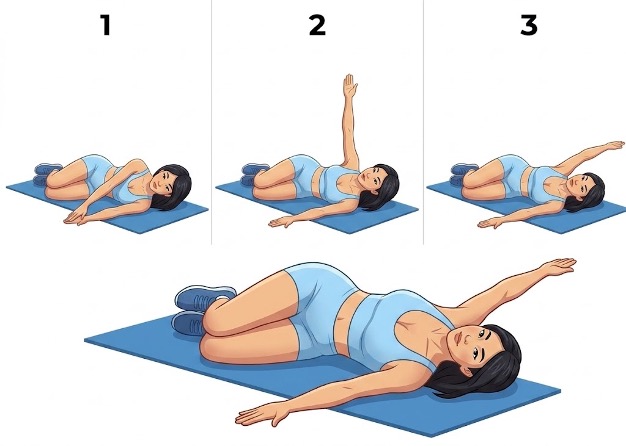
1. The Open Book: Unwind the Desk Posture
When we spend our days with our arms out in front of us, our thoracic spine (the mid-back) becomes locked in a forward curve, and our chest muscles tighten. This restricts our breathing and pulls our neck out of alignment. The Open Book stretch is a beautiful, functional movement that reverses this pattern, encouraging deep rotation and opening the chest.
How to Use It: Lie on the floor or your bed on your side, with your knees bent and pulled up toward your chest to protect your lower back. Stack your arms straight out in front of you, resting your palms together. Slowly lift your top arm and trace a rainbow over your body, reaching back behind you as far as is comfortable while letting your head and eyes follow your moving hand. Keep your knees glued together. Take a deep breath into the stretch, then slowly return to the starting position. Repeat 5 to 8 times on each side.
2. The Pelvic Rock: Reset the Lower Back
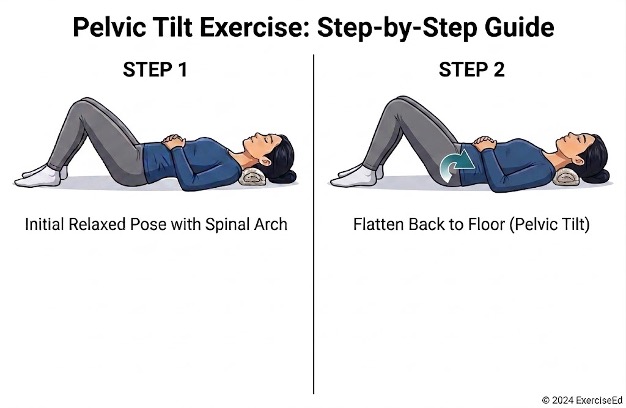
Your lower back works tirelessly all day to keep you upright, acting as the primary shock absorber for your entire upper body. By the end of the day, the lumbar spine often feels compressed and stiff. The Pelvic Rock (or pelvic tilt) isn't about deep stretching; it is a subtle mobility exercise designed to rehydrate the spinal discs and release tension in the lower back muscles.
How to Use It: Lie flat on your back with your knees bent and your feet resting flat on the mattress. Place your hands on your hip bones. Gently rock your pelvis backward, pressing the small of your lower back flat into the bed. You should feel your core lightly engage. Hold for a brief second, and then rock your pelvis forward, allowing that natural arch to return to your lower back. Move slowly and rhythmically back and forth 10 to 15 times, treating it like a gentle massage for your spine.
3. The Supported Child’s Pose: Decompress the Day
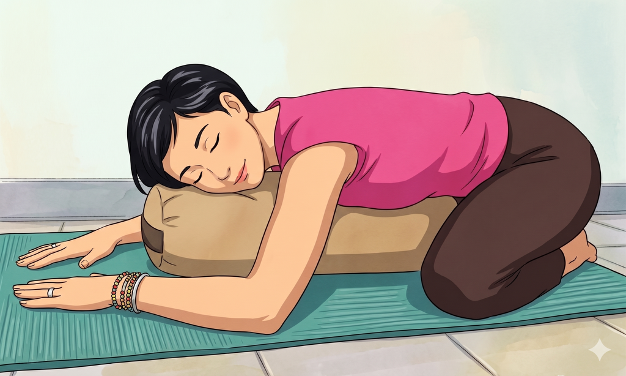
If there is one posture that universally signals "safety" to the human nervous system, it is this one. The Supported Child's Pose gently decompresses the spine from the neck all the way down to the tailbone. It is the perfect final transition before shifting into your preferred, supported sleep position.
How to Use It: Kneel on your bed or a soft mat, bringing your big toes together and taking your knees slightly wider than your hips. Place a thick pillow (or two) vertically in front of you. Slowly hinge at your hips and fold forward, resting your torso and one cheek completely on the pillow. Let your arms rest softly by your sides or draped forward. This is a wonderful moment to turn on your natural essential oil diffuser—perhaps with a few drops of cedarwood or bergamot—to anchor this physical release with a calming sensory cue. Rest here for 1 to 2 minutes, switching which cheek is resting on the pillow halfway through.
Taking three minutes before you pull up the covers isn't about pushing your flexibility limits or achieving a perfect stretch. It is a preventative step that pays dividends in how you feel the next morning. When you gently guide your body out of its daily physical holding patterns, you aren't just avoiding tightness—you are actively participating in your own recovery.
You are reminding your joints how they were designed to move, and you are giving your mind permission to finally power down.
Remember, consistency will always beat intensity. Be kind to your spine, move within a pain-free range, and let your breath guide the pace. We are in this together, and your body is incredibly capable of healing when given the right environment.
References